
Professional Certificate in Data Science & AI
This course now carries Applied Data Science & AI.
66 hours, onsite or live online. Closed corporate groups on request from 5 participants.
Malaysia training provider: 360DigiTMG Sdn Bhd (MyCoID 1265527-M).
SUNY Potsdam certification pathway: Data Science.
HRD Corp claimable; we support the documentation.
- 66 programme training hours
- 60 Hours Streaming Hours & Coursework
- 30 Hours Real-Time Industry Projects
- Domain Specific Virtual Internship
- HRD Corp claimable, we support the documentation
Academic Partners & International Accreditations




Calendar-for-Virtual Interactive Classes
Start Date
Data Science & AI

Total Duration
4 Months

Prerequisites
- Computer Skills.
- Basic Mathematical Knowledge.
Data Science & AI Programme Overview
Learn how to harness the power of data for smart business decision-making with the Professional Certificate in Data Science and AI. The nine-day Data Science training course in Malaysia is designed for both beginners and professionals who want to build a career in Data Science. Participants will develop a strong foundation in Data Science, AI and Deep Learning using Python and R. Students will dive into the architecture of the Relational database and learn to store and manipulate data using SQL and will also discover the difference between SQL and NoSQL databases.
Potential techniques such as Statistical Analysis, Regression Analysis, Data Mining Unsupervised, Machine Learning, and Forecasting are trained with real-time projects. Students will get exposure to all the advanced Data Science tools such as Python, Tensorflow, Keras, OpenCV, and R. A module is dedicated to Python programming that will teach the fundamentals of data structures and you will learn how to create algorithms and how to test and debug Python code. With a dedicated team of trainers and personalized mentorship, the students will gain adequate knowledge and will be able to deliver outstanding results.
Data Science and AI
Data Science & AI Learning Outcomes
By this Professional Certificate course in Data Science and Artificial Intelligence in Malaysia, students/ professionals work with tools and advanced techniques used for the analysis of structured and unstructured data. Participants will learn concepts of Database Management System, how organizations store huge data in their databases, organize data into databases, extract the data, manipulate the data using query language SQL. Students will also discover the difference between SQL and NoSQL databases along with the various concepts involved.
Will be able to perform text mining to generate customer sentiment analysis. Perform forecasting to take proactive business decisions. There is enormous scope for a lucrative career in this domain. By using the cutting edge and appropriate tools like Python, R, Keras the freshers and professionals will be able to build algorithms and analyze huge data. Students will also learn about the various components of Python programming and how to construct basic Python programs with expressions, statements, variables, blocks, functions, comments, logic, and conditionals, which are vital concepts in computer programming.
By using the opportunity of individual attention given by experts at 360DigiTMG, the students will be adequately trained and will be able to understand the course very effectively. Students will be exposed to real-time projects, at the learning level only they are prepared to face the challenges that are inclined to be in industries. Data Science and AI are not confined to a specific industry, so the professionals in data science and Artificial Intelligence will have the liberty to work in the areas of their interest. The primary objective of Data Science and Artificial training at 360DigiTMG is to deliver skilled professionals by providing quality training, guiding them to implement and gain hands-on experience.
- Use data generation sources
- Work with tools and techniques used for the analysis of structured and unstructured data
- Gain strong conceptual knowledge of the Python Programming Language
- Understanding how the database is organized and stored in the database
- How to interact with the database using SQL language for our day-to-day operations
- Ability to Install the databases on the servers
- Understand the differences between Descriptive and Predictive Analytics
- Build prediction models for day-to-day applications
- Perform forecasting to take proactive business decisions
- Analyse texts, images and videos
- Use Python libraries such as Keras, TensorFlow and OpenCV to create AI and Deep Learning solutions
- Apply graphical processing units (GPUs) in Deep Learning Algorithms
- Perform Text Mining to generate Customer Sentiment Analysis
- Apply data-driven, Machine Learning approaches for business decision-making
Data Science and AI Training Modules
By the professional certification course in Data Science and AI in Malaysia, students will learn important tools like Python, Keras, Tensor flow, R, and many more. The modules begin with an introduction to a database management system where they will explore the various applications of DBMS and how this technology is being leveraged to store and retrieve data with utmost efficiency. Learn about the Linear regression, Logistic regression, Naive Bayes, Decision Trees, Support Vector systems, and so on. Will Understand the evolution of AI and Deep Learning and learn the various applications of Deep Learning in building Artificial Intelligence applications.
Understand about extracting features from structured as well as unstructured data such as videos, images, audio, textual files, etc. A major branch of study in data science is Machine Learning also called Data Mining Supervised Learning or Predictive Modelling. One will learn about K Nearest Neighbors (KNN), Decision Tree (Boosting), Random Forest (Bagging), Stacking, Ensemble models, and Naïve Bayes. Students will gain knowledge about the various regularisation techniques and will be able to evaluate overfitting (Variance)and Underfitting(bias). The concluding module will teach you coding with the help of Python programming its use to create web applications. And many effective and significant modules are covered to generate workforce to the changing business trends. All these are explained using industry relevant use cases and mini-projects.
You will learn the concepts and design of a Database Management System. How organizations store huge data in their databases, organize data into databases, extract the data, manipulate the data using query language SQL. You will also explore the difference between SQL and NoSQL databases.
- MySQL for Structured Database
- NoSQL Database MongoDB
Learn about the Project Management Methodology, CRISP-DM, for handling Data Science projects and various concepts used in defining business problems and then performing data collection in line with business problems. Understand the importance of documenting the business objectives and business constraints so that the entire project is performed to solve business problems. Project charter overview will help participants understand the real-world documentation aspect as well.
Learn about data preparation and data cleansing in data science projects to ensure that appropriate data is provided to the next step. Outlier analysis or treatment, handling missing values using imputation, transformation, normalization/standardization, etc., will be explained in thorough detail. Understand the various moments of a business decision and graphical representation so that structured descriptive analytics or descriptive statistics is performed. This exploratory data analytics is the first step in data analytics to draw meaningful insights.
Learn about applying domain knowledge to the data so that more meaningful variables are derived. Understand two main modules of feature engineering including feature extraction and feature selection. Knowing how to shortlist the critical inputs from trivial many inputs is the key to ensuring the high performance of the machine learning models. Understand about extracting features from structured as well as unstructured data such as videos, images, audio, textual files, etc.
Understand one of the key inferential statistical techniques called Hypothesis testing. Understand various parametric hypothesis tests. Learn about the implementation of a Regression method based on the business problems to be solved. Understand about Linear Regression as well as Logistic Regression techniques used to handle continuous as well as discrete output prediction. Evaluation techniques by understanding the measure of Error (RMSE), problems while building a Regression Model like Collinearity, Heteroscedasticity, overfitting, and Underfitting are explained in detail.
Understand the advanced regression models such as Poisson Regression, Negative Binomial Regression, Zero-Inflated models, etc., used to predict the count output variables. Learn about the various scenarios which trigger the application of advanced regression techniques. Understanding and evaluating the models using appropriate performance and accuracy measures of regression are explained in detail.
Data Mining branch called unsupervised learning is extremely important in solving problems, which require the application of only unsupervised learning tasks and also used to support predictive modeling. Clustering or segmentation has two prime techniques – K-Means clustering, as well as Hierarchical clustering and both, are explained in finer detail. Alongside, participants will also learn about handling datasets with large variables using dimension reduction techniques such as Principal Component Analysis or PCA. Finally one will learn about Association rules also called affinity analysis or market basket analysis or relationship mining.
The majority of unstructured data is in textual format and analyzing such data requires special techniques such as text mining or also called as text analytics. Techniques such as DTM/TDM using Term Frequency, Inverse Document Frequency, etc. are explained in this module. One will also learn about generating a word cloud, performing sentiment analysis, etc. Also, advanced Natural Language Processing techniques such as LDA, topic mining, etc., are explained using practical use cases. Also, the learning includes extracting unstructured data from social media as well as varied websites.
A major branch of study in data science is Machine Learning also called Data Mining Supervised Learning or Predictive Modelling. One will learn about K Nearest Neighbors (KNN), Decision Tree (Boosting), Random Forest (Bagging), Stacking, Ensemble models and Naïve Bayes. One will learn about the various regularization techniques as well as understand how to evaluate for overfitting (variance) and underfitting (bias). All these are explained using industry relevant use cases and mini-projects.
Black box machine learning algorithms are extremely important in the field of machine learning. While there is no interpretation in the models, accuracy is unmatched in comparison to other shallow machine learning algorithms. Learn about the Perceptron algorithm and Multi-layered Perceptron algorithm or MLP. Understand about Kernel tricks used within Support Vector Machine algorithms. Understand about linearly separable boundaries as well as non-linear boundaries and now to solve these using Deep learning algorithms.
Understand the difference between cross-sectional data versus time series data. Search about the forecasting strategy employed in solving business problems. Understand various forecasting components such as Level, Trend, Seasonality & Noise. Also, learn about various error functions and which one is the best given a business scenario. Finally, build various forecasting models ranging from linear to exponential to additive seasonality to multiplicative seasonality.
Understand the evolution of AI and Deep Learning and learn the various applications of Deep Learning in building Artificial Intelligence applications. A brief history of Deep Learning and the pace of progress in the space of deep learning is pivotal for budding and emerging data scientists as well as AI experts. Challenges faced in deep learning along with the best practices to overcome the challenges is also explained in detail.
While there are a lot of statistical software and programming languages to perform deep learning activities, Python stands out from the rest. There are a lot of deep learning libraries such as Keras, TensorFlow, Theano, PyTorch, etc., and one will learn about Keras as well as TensorFlow as part of the training module. Image processing is an amazing field to become proficient at and hence you will also learn OpenCV, which stands for Open Computer Vision. The future belongs to Open-source libraries and the fastest development on emerging algorithms will happen in this space. Learning these concepts will help us gain an edge over competitors.
Understanding the treatment of both linearly separable boundaries as well as non-linear boundaries is pivotal for the success of AI experts as well as Data Scientists. In this module, one will learn about handling linear boundaries using the Perceptron algorithm. Understand how weights are assigned and how they are updated each time to reduce the error function. Learn about the Backpropagation algorithm and its application in reducing error using the Perceptron algorithm.
Understand working with videos and images because the amount of data getting generated in this space is outstripping the volume of textual data. Understand the various features to be extracted from images including edges, textures, etc., by applying various kinds of filters such as Sobel, Harris Corner Detector. Also, learn about face detection using Viola-Jones and tracking human faces in videos. Alongside this also learn about a few image-related models such as image segmentation, image recognition, etc.
Understand how to work with images and videos for building predictive models. Learn about convolution layers as well as handling very small datasets. Understand how to improve the accuracy of models by performing data augmentation activities. Also one should be aware of the use of pre-trained models using feature extraction, fine-tuning, etc., in solving business problems. Finally visualizing the activation layers and heat maps for activation will complete the study to the fullest.
Understand working with textual sequence data and how to perform a one-hot encoding of words and characters. Learn about bi-directional RNNs as well as deep bi-directional RNNs. Learn about various RNN topologies and network architectures. Vanishing and exploding gradient problems are very prevalent in the field of recurrent neural networks. Understand Backpropagation Through Time, which is a different but slight variation from the regular backpropagation algorithm.
Advanced techniques in handling textual and sequential data are LSTMs and GRUs. Also, understand about forecasting temperature. Learn about bi-directional LSTMs and deep bi-directional LSTMs . Also, understand the stacking of various recurrent layers. Stacking recurrent layers will improve accuracy and understanding the same is extremely pivotal for the success of AI algorithms. Also, learn about 1D convolution for time series data. Finally combining CNN and RNN models is an art, which is explained in detail.
Tools Covered












GenAI assistants and models
- ChatGPT
- Claude
- Gemini
- Llama
- Perplexity
AI-assisted and vibe coding
- GitHub Copilot
- Cursor
- Claude Code
- Replit
Agentic AI frameworks
- LangChain
- Hugging Face
- Ollama
Zero-code AI automation
- n8n
- Zapier
- Make
Deploy and MLOps
- MLflow
- Streamlit
- Docker
- Databricks
- AWS
- Google Cloud
Data Science and AI Trends in Malaysia
Data Science with AI is an emerging technology where its benefits are immense in Malaysia. The latest trends in Data Science is the invention of energy-efficient technique with the help of flower pollination algorithm for Cloud Datacentres. Using Data mining techniques are being used in healthcare to predict the risk of disease based on clinical and non-clinical data of individuals. For virtual screening, Deep networks are being used. Artificial Intelligence is evolving from Perpetual intelligence to Cognitive intelligence, this will enable machines in better understanding and utilizing knowledge for delivering better outputs. Advancements in Artificial Intelligence will be used in protecting Data.
Technologies in IoT will be essential for manufacturing companies enabling them to accomplish machine automation and getting introduced to smart manufacturing. Cloud computing is the technology that is being lauded and gaining accolades for its friendly and easy features. It is easily accessible to the users as it is the core of the digital economy. Cloud is being used in all IT technologies like chips, databases, IoT, Blockchain, Quantum computing, and many more. The other trends will be observed in Patent Analytics, market sizing tools, and in Earning Transcripts. There would be a great shift towards real-time analytics, which helps companies to be more productive by making data-driven decisions.
How We Prepare You
-
Additional Assignments of over 140+ hours

-
Live Free Webinars

-
Resume and LinkedIn Review Sessions

-
6 Months Access to LMS

-
Complimentary Courses

-
Hands-on Experience in a Live Project

-
Life Time Free Access to Industry Webinars

Call us Today!
 +60 19-383 1378
Data Science and AI Panel of Coaches

Bharani Kumar Depuru
- Professional Experience: Over 18+ years in data analytics, digital transformation, and Industrial Revolution 4.0.
- Expertise: Specializes in data analytics and digital transformation.
- Corporate Clients: Worked with Deloitte, HPE, Amazon, Tech Mahindra, Cummins, Accenture, and IBM.
- Certifications: PMP, PMI-ACP, PMI-RMP, Lean Six Sigma Master Black Belt, Tableau Certified Associate, Certified Scrum Practitioner.

Samson Swaroop Paturi
- Professional Experience: Over 17+ years in machine learning, AI, and big data/data lake systems.
- Expertise: Specializes in machine learning, AI, and big data.
- Experience: Worked with Capgemini, Florida Power & Light Company, ComTec Information Systems, and IBM.
- Certifications: Certified Scrum Product Owner (CSPO), Six Sigma Green Belt, ITIL Foundation Level, IBM logo Advisory Product Services Professional.

Aman
- Professional Experience: Over 10 years of experience in Data Science and Analytics.
- Expertise: Specializes in Analytics, Business Intelligence (BI), Data Science, and Artificial Intelligence (AI).
- Solutions Experience: Senior Data Specialist at 360DigiTMG and AiSPRY.
- Certifications: Python, SQL, Power BI, Tableau.
Data Science and AI Course Certificate
Get recognized for your advanced data skills with the Professional Certificate in Data Science and AI. Make your mark in the highly competitive AI talent market.
**All certificate images are for illustrative purposes only. The actual certificate may be subject to change at the discretion of the Certification Body.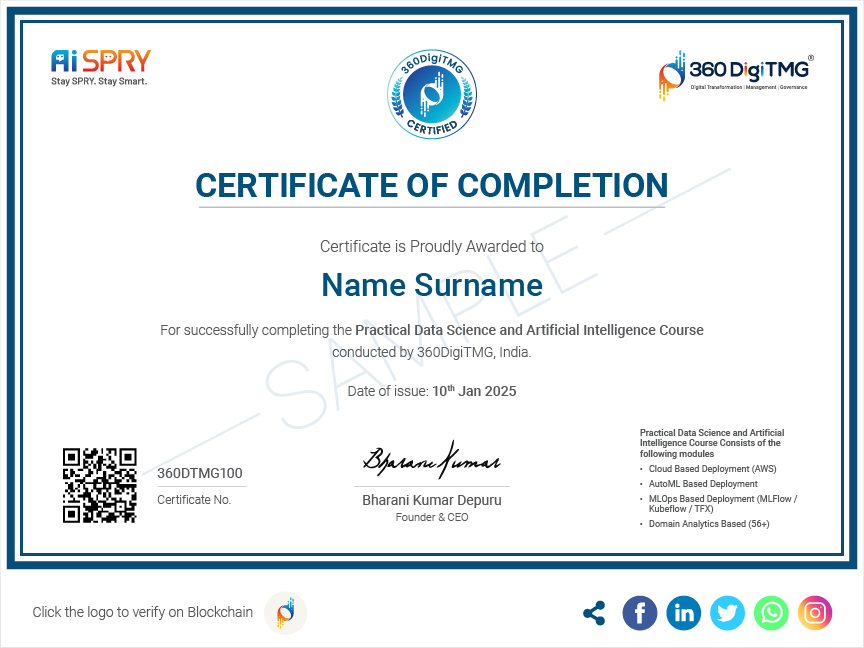

Alumni Speak
"Coming from a psychology background, I was looking for a Data Science certification that can add value to my degree. The 360DigiTMG program has such depth, comprehensiveness, and thoroughness in preparing students that also looks into the applied side of Data Science."
"I'm happy to inform you that after 4 months of enrolling in a Professional Diploma in Full Stack Data Science, I have been offered a position that looks into applied aspects of Data Science and psychology."

"360DigiTMG’s Full Stack Data Science programme equips its graduates with the latest skillset and technology in becoming an industry-ready Data Scientist. Thanks to this programme, I have made a successful transition from a non-IT background into a career in Data Science and Analytics. For those who are still considering, be bold and take the first step into a domain that is filled with growth and opportunities.”
"360DigiTMG is such a great place to enhance IR 4.0 related skills. The best instructor, online study platform with keen attention to all the details. As a non-IT background student, I am happy to have a helpful team to assist me through the course until I have completed it.”
"I think the Full Stack Data Science Course overall was great. It helped me formalize and think more deeply about ways to tackle the projects from a Data Science perspective. Also, I was remarkably impressed with the instructors, specifically their ability to make complicated concepts seem very simple."
"The instructors from 360DigiTMG were great and it showed how they engaged with all the students even in a virtual setting. Additionally, all of them are willing to help students even if they are falling behind. Overall, a great class with great instructors. I will recommend this to upcoming deal professionals going forward.”
Our Alumni Work At
And more...
FAQs for Data Science and AI Course
After you have completed the classroom sessions, you will receive assignments through the online Learning Management System that you can access at your convenience. You will need to complete the assignments in order to obtain your data scientist certificate.
If you miss a class, we will arrange for a recording of the session. You can then access it through the online Learning Management System.
We assign mentors to each student in this programme. Additionally, during the mentorship session, if the mentor feels that you require additional assistance, you may be referred to another mentor or trainer.
No, the cost of the certificate is included in the programme package.


Salaries in Malaysia for Data Science and AI

Data Science and AI Projects in Malaysia
Many innovative projects in the field of Education, Health care, Clinical research, Environmental Monitoring, Fashion Industry, Banking, Infrastructure services, Legal are ongoing with the aid of Data Science and Artificial Intelligence in Malaysia.

Role of Open Source Tools in Data Science and AI
There are many popular tools in Data Science that are used extensively like Python, R, R studio, Tableau, Tensor flow, Keras, Terax, Jupiter, Numpy, Pandas, Pytorch, Scipy, Spider. This helps in solving Data Science algorithms.
Modes of Training in Data Science and AI

Industry Applications of Data Science and AI in Malaysia
Malaysia is adapting Data Science and Artificial Intelligence in industries to be efficient in production. Health care, Banking, Legal, Education, Defence, Infrastructure services are relying on Data Science and Artificial Intelligence.
Companies That Trust Us
360DigiTMG offers customised corporate training programmes that suit the industry-specific needs of each company. Engage with us to design continuous learning programmes and skill development roadmaps for your employees. Together, let’s create a future-ready workforce that will enhance the competitiveness of your business.




Student Voices

Sana Ahsan
5 years ago
Suriyaa Kumar
5 years agoI attended the Certification in Data Science program by 360DigiTMG. The course was amazing. I had a great learning & networking experience. Also, trainers are highly experienced and knowledgeable in the field of Data Science. I will recommend this course to anyone who wants to become a Data Scientist.

Asyraaf Afandi
5 years agoI joined the Data Science Certification Program which is a great place to learn if you want to start your career in the Data Science industry. The trainers are very knowledgeable and will try to explain the topics until you truly understand it. I would definitely recommend others to join it.

Iqmal Harris
5 years agoThe courses are taught by seasoned industry experts who know how to train absolute beginners and established professionals alike. Glad to have trained under 360DigiTMG.

Zarif Iqram
4 years agoI worked on a Survival Analysis project, which gave me good exposure and boosted my skill set in Business Intelligence with Power BI. Good to have it more and be involved in the real-time projects.
360DigiTMG - Data Science, IR 4.0, AI, Machine Learning Training in Malaysia
Level 16, 1 Sentral, Jalan Stesen Sentral 5, Kuala Lumpur Sentral, 50470 Kuala Lumpur, Federal Territory of Kuala Lumpur, Malaysia
Data Science and AI Course Other Locations: - Data Science Training in Malaysia, Data Science Training in Malaysia, Data Science Certification in Malaysia, Data Science Institute in Malaysia, Data Science in Kuala Lumpur, Data Science in Penang, Data Science in Johor, Data Science in Hyderabad, Data Science in Bangalore, Data Science Malaysia, Data Scientist Malaysia, Data Scientist Course Malaysia. Explore Data Science and AI courses designed for aspiring Data Scientists across Malaysia. Acquire practical, hands-on training and certification, supported by mentors to enhance your skills. Prepare for a successful career in the dynamic fields of Data Science and AI with comprehensive learning experiences and professional guidance.
What stood out most was the programme's practical and structured approach to AI adoption. The industry-specific examples, combined with clear frameworks for evaluating feasibility and designing solutions, made the learning highly relevant to our business.
What stood out most was the trainer's simple way of explaining Data Science and GenAI, and showing us different AI tools that I had not used before. It made me realise how useful these tools can be in our daily work.