

Home / Blog / Data Science Digital Book / Recommender Systems
Recommender Systems


Meet the Author : Mr. Bharani Kumar
Bharani Kumar Depuru is a well known IT personality from Hyderabad. He is the Founder and Director of AiSPRY and 360DigiTMG. Bharani Kumar is an IIT and ISB alumni with more than 18+ years of experience, he held prominent positions in the IT elites like HSBC, ITC Infotech, Infosys, and Deloitte. He is a prevalent IT consultant specializing in Industrial Revolution 4.0 implementation, Data Analytics practice setup, Artificial Intelligence, Big Data Analytics, Industrial IoT, Business Intelligence and Business Management. Bharani Kumar is also the chief trainer at 360DigiTMG with more than Ten years of experience and has been making the IT transition journey easy for his students. 360DigiTMG is at the forefront of delivering quality education, thereby bridging the gap between academia and industry.
Recommender Systems is also called Collaborative Filtering.
'Users' are typically the rows in the data utilised for the analysis, and 'Items' will be the columns. (from retail ecommerce context)
Whether a user has
purchased or not
Whether user has rated
the product or not
How many products each
user has purchased?
What is the rating
provided by the user?
Click here to learn Data Science in Hyderabad
The values, such as ratings columns, are occasionally split by frequency. The quantity of buyers or raters is referred to as the frequency. The ratings are normalised throughout this procedure.
applied often on e-commerce sites. To create personalised tactics to propose products with a high likelihood of being purchased, customers' purchasing behaviours are examined.
- What is the item most likely to be purchased?
- Can we identify and make suggestions/recommendations upfront?
It is necessary to respond to these two basic questions. Recommendations in turn assist the user develop confidence in themselves and brand loyalty.
Types of Recommendation Strategies
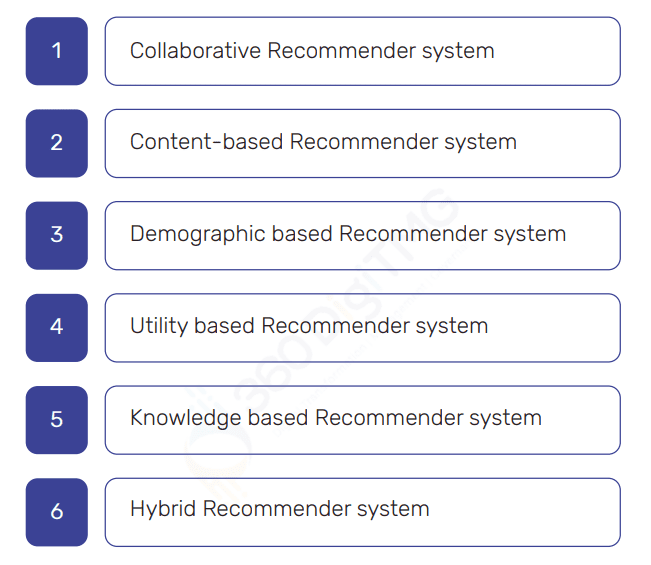
The most often used method is collaborative filtering, which relies on user similarity metrics.
Similarity Measures:
Cos(A,B) = A•B / |A|*|B|
Corr(AB) = Covariance (A,B) / Stdev (A) * Stdev (B)
Euclidean distance
Manhattan distance, etc.
What to Recommend:
List the products that the individual is MOST LIKELY to buy from the list of products that customers with comparable buying patterns have already purchased.
Sorting the list of items can be based on:
- How many similar customers purchased it
- Rated by most
- Highest rated, etc.
Disadvantages:
Costly memory and lazy learning
Compute is relatively costly - n computations for similarities
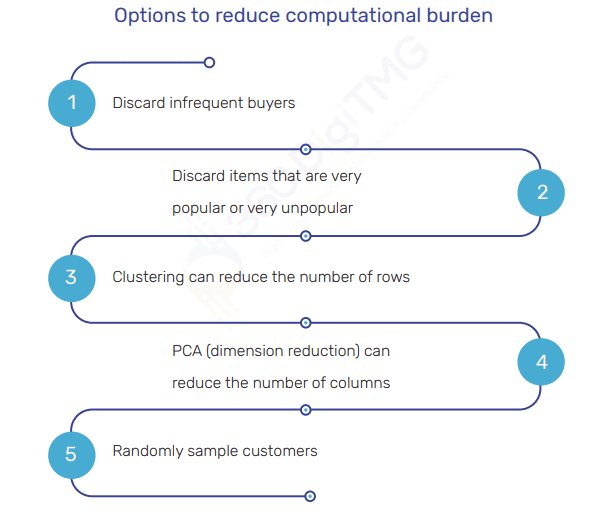
Alternative Approaches
Making strategic decisions in comparison to suggestions with "Better accuracy and offline" vs. "Slightly lower accuracy and online"
Recommendations vs Association Rules
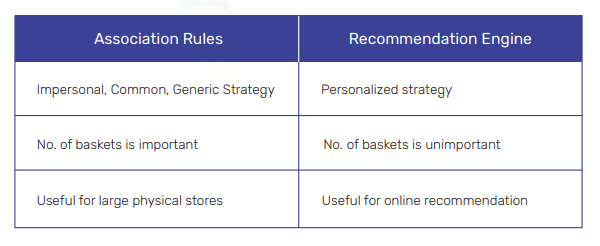
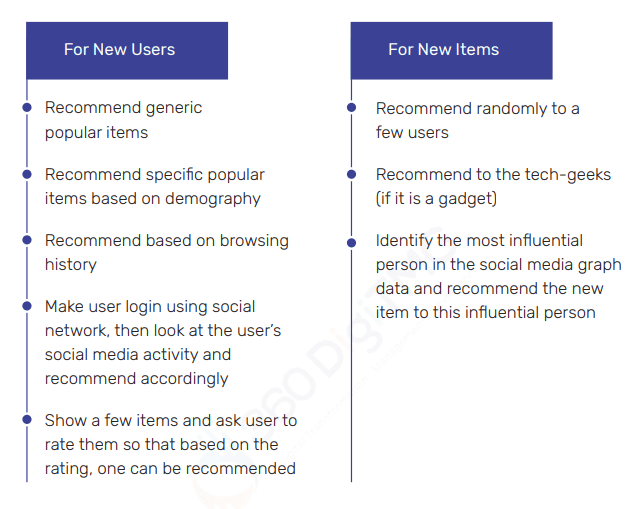
Challenge with Rating Matrix-Based Recommendation:
The number of vacant cells in rating matrices makes them large and sparse.
The sparse rating matrix is handled using the SVD algorithm.
Data Science Placement Success Story
Data Science Training Institutes in Other Locations
Navigate to Address
360DigiTMG - Data Science, IR 4.0, AI, Machine Learning Training in Malaysia
Level 16, 1 Sentral, Jalan Stesen Sentral 5, Kuala Lumpur Sentral, 50470 Kuala Lumpur, Wilayah Persekutuan Kuala Lumpur, Malaysia
+60 19-383 1378
Get Direction: Data Science Course


What stood out most was the programme's practical and structured approach to AI adoption. The industry-specific examples, combined with clear frameworks for evaluating feasibility and designing solutions, made the learning highly relevant to our business.
What stood out most was the trainer's simple way of explaining Data Science and GenAI, and showing us different AI tools that I had not used before. It made me realise how useful these tools can be in our daily work.